
Daniel and His Problems
Notes on Anatomy of a Fall and Hamlet
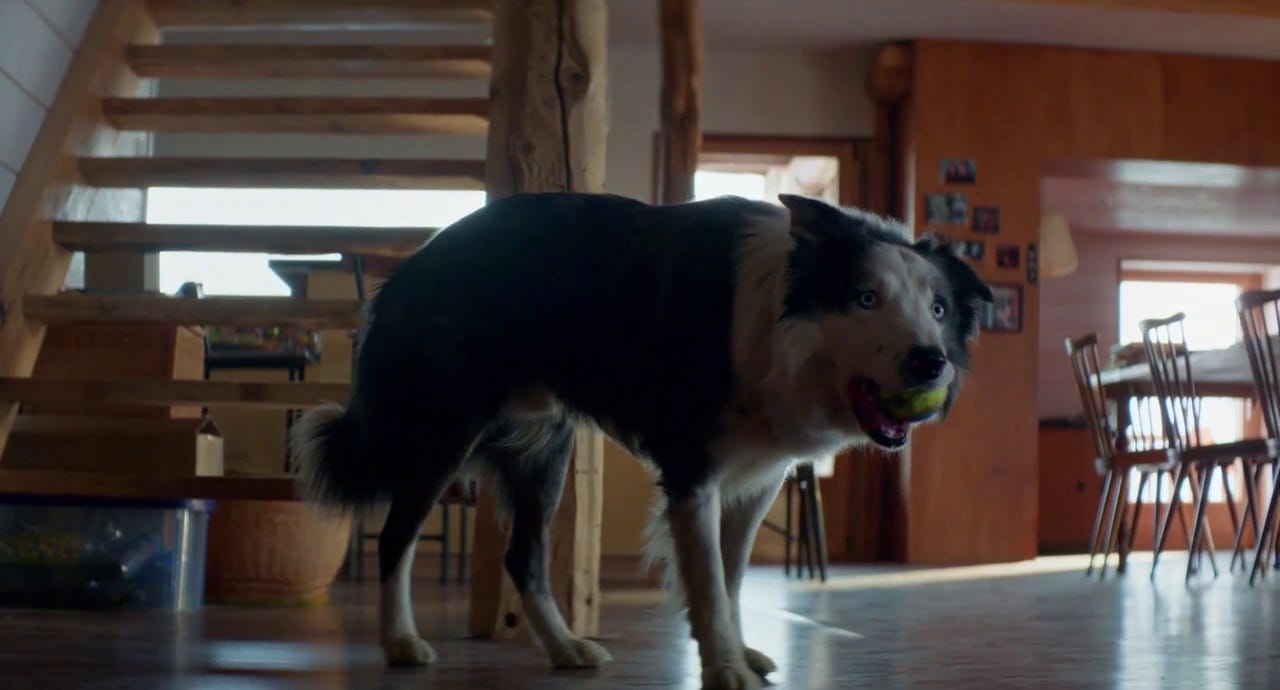
You look like a dog…
—Vincent to Sandra in Anatomy of a Fall
“Like a dog!”
—Franz Kafka, The Trial
I loved you ever. But it is no matter.
Let Hercules himself do what he may,
The cat will mew, and dog will have his day.
—Hamlet, 5.1

What is comparison good for? Many things, as it turns out, but it is also the case that comparative approaches to cultural studies can become tedious or impertinent when they increasingly seem to connect one thing with another on a whim. But I don’t think it is impertinent to compare Justine Triet’s Anatomy of a Fall (2023) to Shakespeare’s Hamlet (c. 1599). We can find parallels—or perhaps we should say homologies—between the two texts at various levels: those of composition, genre, narrative structure, thematics, and form—especially if the latter is understood in a narrow sense, because both works turn out to be formally oriented toward the production, if not the maintenance, of ambiguity.
Compositionally, both works are at once markedly derivative and remarkably original. This is hardly the place to rehearse the confusing and murky textual history of the Hamlet texts, but we can note in passing that Triet, too, may be said to be ‘reworking’ an ‘Ur-Hamlet’ of her own, even if she is not literally reworking Hamlet itself: like Shakespeare she has precursors she scarcely bothers to hide.
With regard to genre we will want to note that the homology between the English tragedy and the contemporary thriller, policier, procedural, and courtroom-drama is almost self-evident: each of these genres, regardless of its relative modernity, is inordinately preoccupied with justice and guilt, crime and revenge, proof and knowledge, conscience and trust. And we will find that just as Hamlet is one of our first hard-boiled detectives, in Triet’s film an as-yet unembittered son sets out to investigate and, perhaps, take justice into his own hands.
In narratological terms we will have to admit that Elizabethan tragedy and contemporary cinema do not operate in the same ways; here the comparison is primarily interesting for how it highlights a difference. For if, as a tragedy, Hamlet ends in a massacre and political chaos, Anatomy of a Fall is then remarkable for how well it ends without being any less disquieting for it. But we can also note that both dramas work very carefully to manage how much information we receive and undermine our sense of that information’s reliability.
If we approach the two texts thematically, then suddenly the resemblance leaps into focus. But just as Anatomy of a Fall has been reductively compared to ‘prestige TV’ (as I have observed elsewhere, cineastic discourse all too often falls back upon a profoundly ideological distinction between “high art” and “mass culture”), so too has even Hamlet been dismissed, and not, in this case, by some marginal commentator: Hamlet probably has no ‘hater’ more famous than T. S. Eliot.
Eliot begins his 1919 essay “Hamlet and His Problems” by considering the relation of critics to a beloved text:
Few critics have ever admitted that Hamlet the play is the primary problem, and Hamlet the character only secondary. And Hamlet the character has had an especial temptation for that most dangerous type of critic: the critic with a mind which is naturally of the creative order, but which through some weakness of the creative power exercises itself in criticism instead. These minds often find in Hamlet a vicarious existence for their own artistic realization. (141)
Of course the set of critics guilty of such fabulation turns out to include figures such as Goethe and Coleridge (not to mention Freud and Lacan), so those who find vicarious artistic realization in Hamlet-interpretation are, at least, in good company. But for all that Eliot’s foundational work toward the so-called “New Criticism” now appears fraught and contentious, his criticism turns out (with amusing irony) to be guilty of being as ‘dangerous’ as that of Coleridge. Because of course Eliot was himself a critic “with a mind which is naturally of the creative order,” and his essays—no less than, and perhaps even more than his poetry—are replete with bizarre insights that remain suggestive. And it turns out, I think, that Eliot’s essay on Hamlet and its problems can serve as a key for understanding a film he may well have enjoyed.1
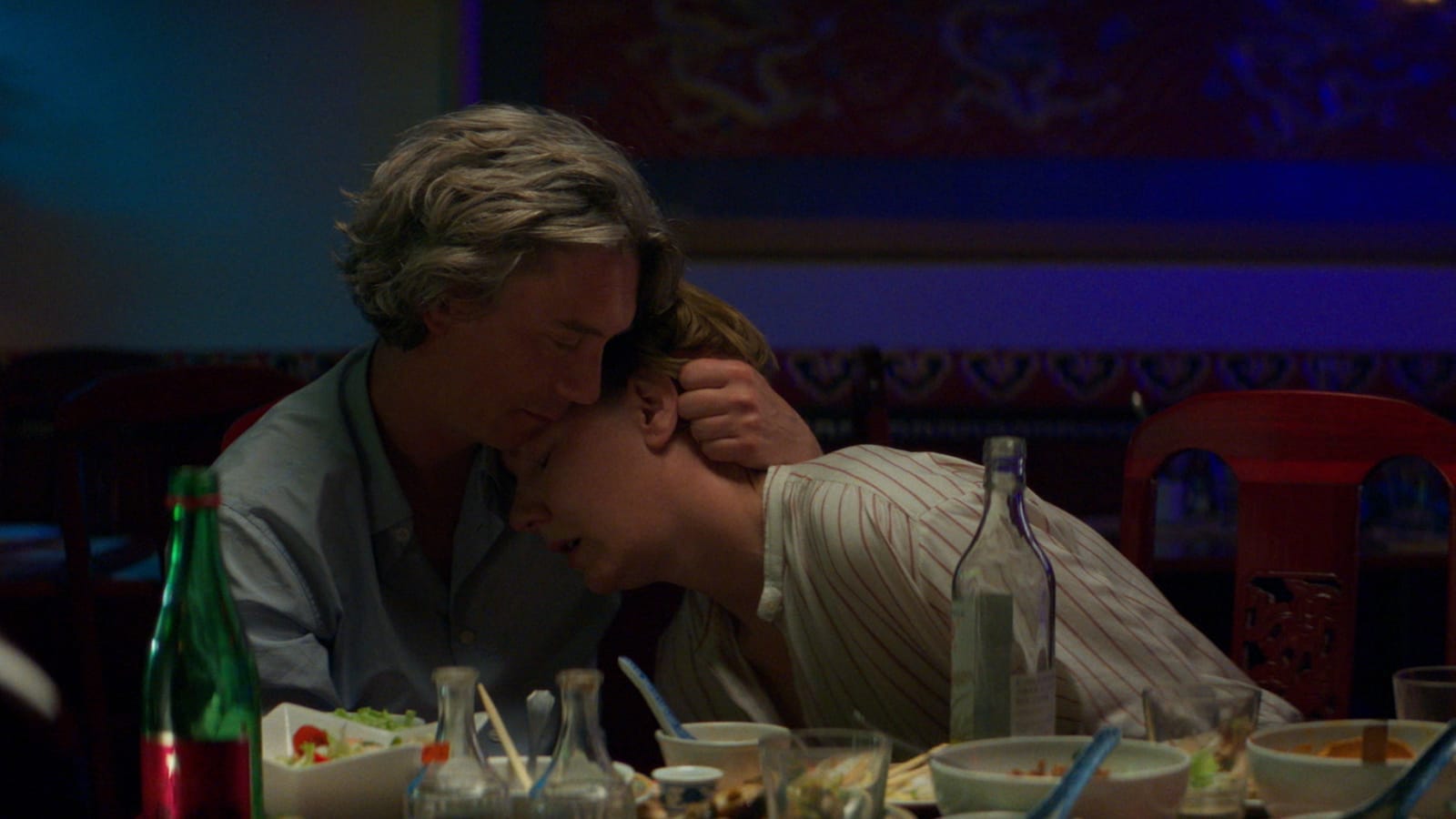
After all, and as cannot have only occurred to me, Anatomy comes to resemble Hamlet more than it does its cinematic namesake (Preminger’s Anatomy of a Murder of 1959). Sandra is a kind of Gertrude2; her lawyer and old friend, Vincent, seems to be on the cusp of becoming her hastily-married new husband, à la Claudius; and Daniel, the child who turns out to be the ultimate protagonist of the film, investigates and (silently, unlike Hamlet) ponders his mother’s potential guilt. Of course where Hamlet rather spectacularly fails (recall the final tableau not-so vivant, corpses literally placed on display), Daniel succeeds, and it is in the ambiguity and allegorical resonance of this success that the interest of the film resides.
Eliot’s view of Hamlet turns out to also function as a working definition of Anatomy of a Fall both in itself and to the extent that it adapts (consciously or unconsciously) Shakespeare’s tragedy:
Hamlet, so far as it is Shakespeare’s, is a play dealing with the effect of a mother’s guilt upon her son […] Shakespeare was unable to impose this motive successfully upon the ‘intractable’ material of the old play.
Of the intractability there can be no doubt. So far from being Shakespeare’s masterpiece, the play is almost certainly an artistic failure. In several ways the play is puzzling, and disquieting as is none of the others. […] And probably more people have thought Hamlet a work of art because they found it interesting, than have found it interesting because it is a work of art. It is the ‘Mona Lisa’ of literature. (143-4)
For our purposes it will be neither helpful nor interesting to elaborate further an analogy between the textual history of Hamlet and its Ur-text(s) and Anatomy’s status as a generic intervention. And as for Eliot’s infamous claim that Hamlet is “almost certainly an artistic failure”: it turns out that the “almost,” and not the “certainly,” was the operative word. I would say, however, that that last (and now famous) line about the Mona Lisa is interesting and helpful.
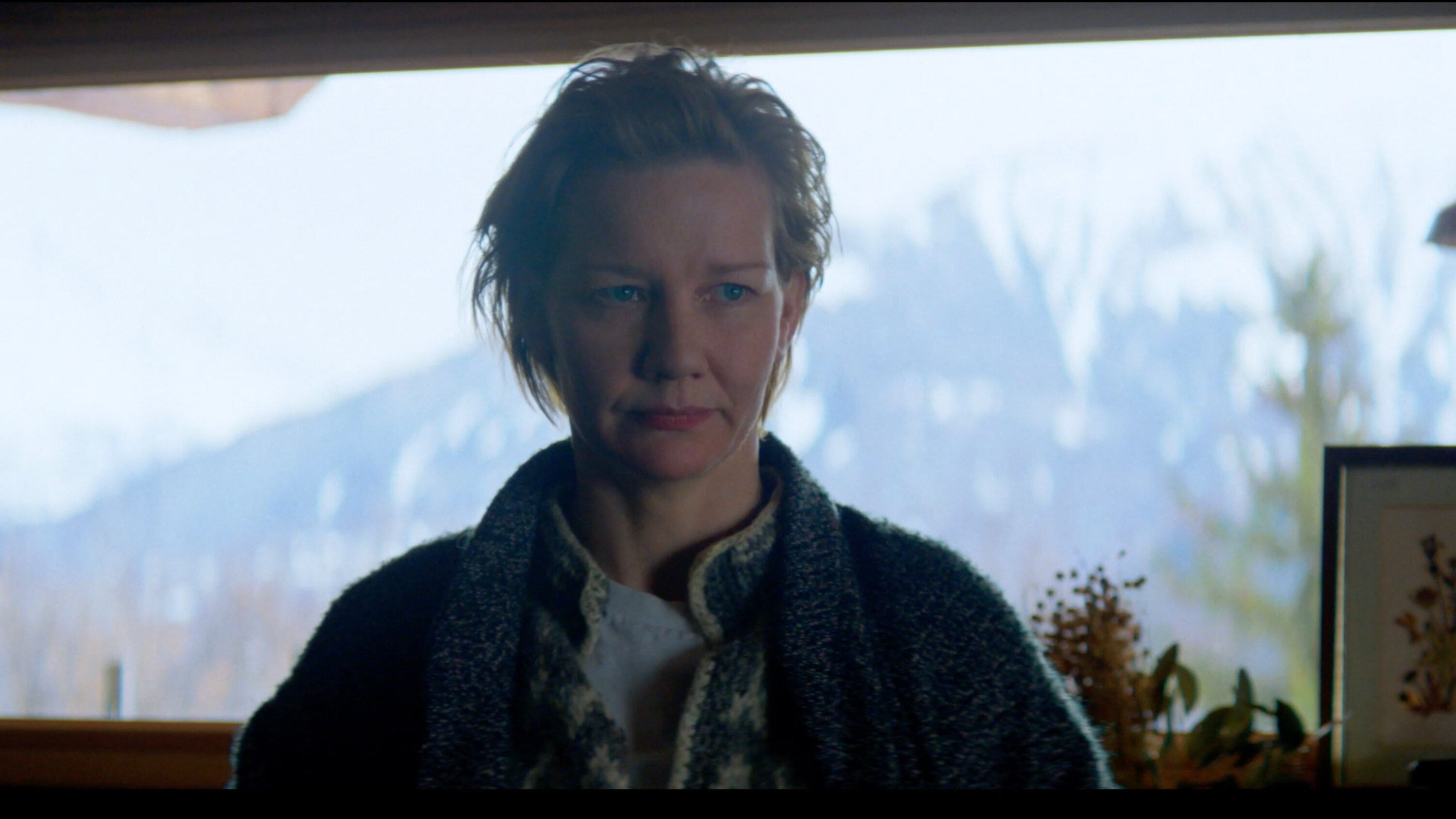
Something peculiar happened as I was trying to explain to a friend the parallels or homologies I see between Anatomy and Hamlet: I misquoted Eliot and said that he says that Gertrude is the “‘Mona Lisa’ of literature,” instead of the play itself. What he actually says about Gertrude is rather different. After elaborating the all-too influential concept of the “objective correlative,” which is supposed to be missing from Hamlet, Eliot writes:
To have heightened the criminality of Gertrude would have been to provide the formula for a totally different emotion in Hamlet; it is just because her character is so negative and insignificant that she arouses in Hamlet the feeling which she is incapable of representing. (146)
To our relief, perhaps, we will quickly find that the son in Anatomy, Daniel, does not resemble Hamlet any more than Sandra is “incapable” of representing some resentment that Daniel feels:
Hamlet is up against the difficulty that his disgust is occasioned by his mother, but that his mother is not an adequate equivalent for it; his disgust envelops and exceeds her. (145)
Whatever that means. We can, I think, afford to jettison Eliot’s reading of the details of the play, or focus on how Anatomy is not like this view of Hamlet, while holding on to his diagnosis of the play’s central problematic: “the effect of a mother’s guilt upon her son,” as Eliot puts it. This is, of course, the problem Daniel faces, but not because he resembles Hamlet.
In fact the character who most resembles Hamlet in Anatomy is not the bereaved son but the dead father. Samuel is a would-be writer who, in a reversal of what Nietzsche called ‘the Hamlet doctrine,”3 can act (he teaches, he renovates the family home, he parents) but not do things with words: he cannot write, as the celebrated argument-recording centerpiece of the film discloses: his wife claims he is “petrified by his own fucking standards.” Sandra, on the other hand, has been very successful as a writer—as someone who does things with words—but is also almost certainly shirking action (her duties as a parent) as a result, or so Samuel claims. This contradiction or tension in the marriage (we cannot really know which it is), and its relation to Samuel’s death, is worked-over in detail in the course of the trial. The point, however, is not what Sandra’s character suggests to us about something as topical as autofiction. The point is how Daniel resolves or dissolves that tension or contradiction—which becomes, through the trial, a very real threat to what is left of his life—and in doing so rewrites “the Hamlet doctrine” for our time.
As critic Lawrence Garcia observes:
Although there are shades of Preminger in the way [Triet] keeps Hüller’s Sandra at a somewhat chilly remove, limiting our identification with her, Triet does not generally attempt to replicate the American director’s fluid camerawork. Indeed, a more apt cinematic precursor may be Claude Chabrol, particularly his use of structure to destabilize the certitude of ostensibly objective images, as in films like Violette Nozière (1978) and The Color of Lies (1999). Of note in Anatomy of a Fall are two key flashbacks involving Samuel (who otherwise goes unseen), the second of which is tied to a late-game identification shift to Daniel, whose belief in his mother moves to the film’s narrative center.
It is precisely the destabilized certitude of Daniel’s ostensibly objective ‘flashbacks’ (if that is what they are) that indicates how he will differentiate himself, decisively, from his parents, in order to preserve what is left of the family as such—which is, as you may recall, what the ghost ordered Hamlet to do, and what that son failed to accomplish:
But howsomever thou pursues this act
Taint not thy mind nor let thy soul contrive
Against thy mother aught; leave her to heaven
And to those thorns that in her bosom lodge
To prick and sting her. (1.5.84-7)
But what is interesting about Daniel is not that he succeeds where Hamlet fails. That doesn’t really mean anything: they’re two different fictional characters, non-identical, and they come to us from radically different historical moments. What is interesting is that the film itself, by destabilizing the objectivity of its images through Daniel’s fictional flashbacks, has implied a parallel between the ambiguity of cinematically realist images and fictionality itself. Daniel cannot have seen the argument that Samuel recorded, so when we see it we are presumably ‘watching’ him imagine or, if you like, restage that argument; this calls into doubt his pivotal final ‘recollection’ about his father.
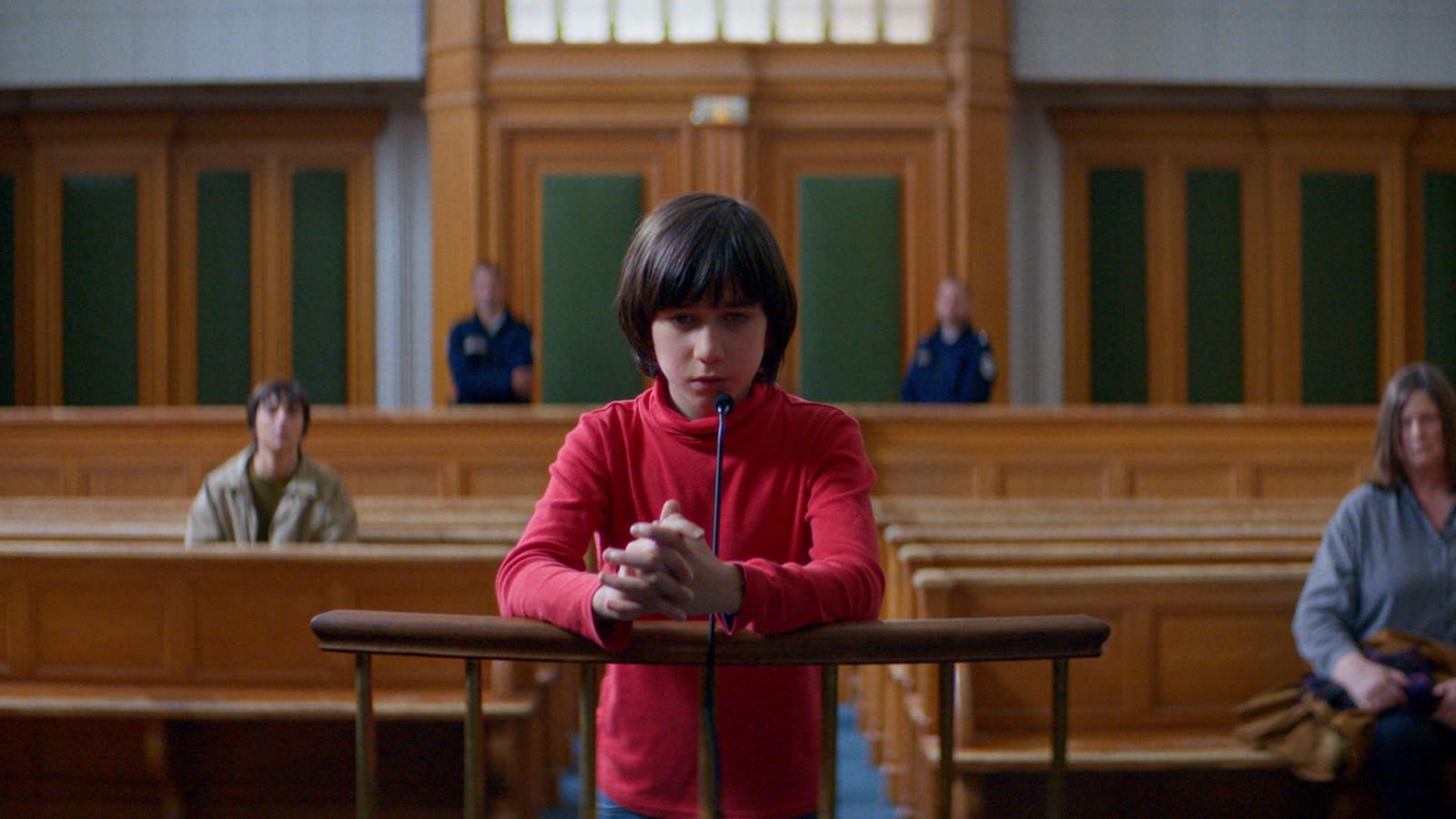
These flash-backs, which suddenly create a pointed lack of distinction between objectivity and subjectivity within the diegesis, seem to constitute ruptures of the kind that Gérard Genette terms “paralepsis”: “giving more [information] than is authorized in principle by the code of focalization governing the whole” (195). But of course the flashbacks really accomplish what Garcia calls a “late-game identification shift to Daniel,” or what I would describe as a revelation of the film’s focalization; we understand, finally, that the film is Daniel’s.
Why should the film do this? Why should it withhold clarity of focalization from its audience? for the sake of surprise or suspense? No, the grounds for this have to do with the form/content distinction (your favourite and mine), which is here explored to great effect. Because it is precisely the trial itself, as an actual crisis for Daniel as a character, that motivates him to scrutinize his memories and, in turn, testify to them more strategically. This is foreshadowed for us in the early scene that has the investigators re-enact a moment prior to the murder in order to test Daniel’s memory: they demonstrate that he had misremembered (or else misrepresented his memories in order to defend his mother—hint hint!). As Genette remarks:
Narrative always says less than it knows, but it often makes known more than it says. (198)
We are not initially given any formal indication that the film is focalized through Daniel because Daniel does not initially understand that this is his story: as it was for Hamlet, the death of a father is for Daniel shocking, bewildering, confusing, and profoundly upsetting, which would promise to ‘explain’ his lapses in memory. But later, after Daniel hears the recorded argument between his parents and observes the trial taking turns for the worse, he takes matters into his own hands: he poisons his beloved dog Snoop with aspirin in order to re-enact a memory of a possible suicide attempt made by his father, and then he testifies, one last time, to a conversation he supposedly had with Samuel in which his father, speaking ostensibly about Snoop, urged Daniel to accept that death and loss are inevitable. We are left to wonder whether such a conversation ever occurred.4
This is how Daniel resolves the art/life contradiction or opposition that so vexed his parents: he does what Hamlet could not, and more: he collapses the distance between fiction and life, in what Genette would call “metalepsis”: an unsettling transition or transgression between levels of narration.
Daniel does something with words: he tells a story that probably saves his mother from the retribution of the Law. In fact it doesn’t matter whether he is lying, because his final testimony presumably has the effect he intended: he prevents his family from being broken any further: the opposite of what Hamlet achieves. He is, in this view, a hero.
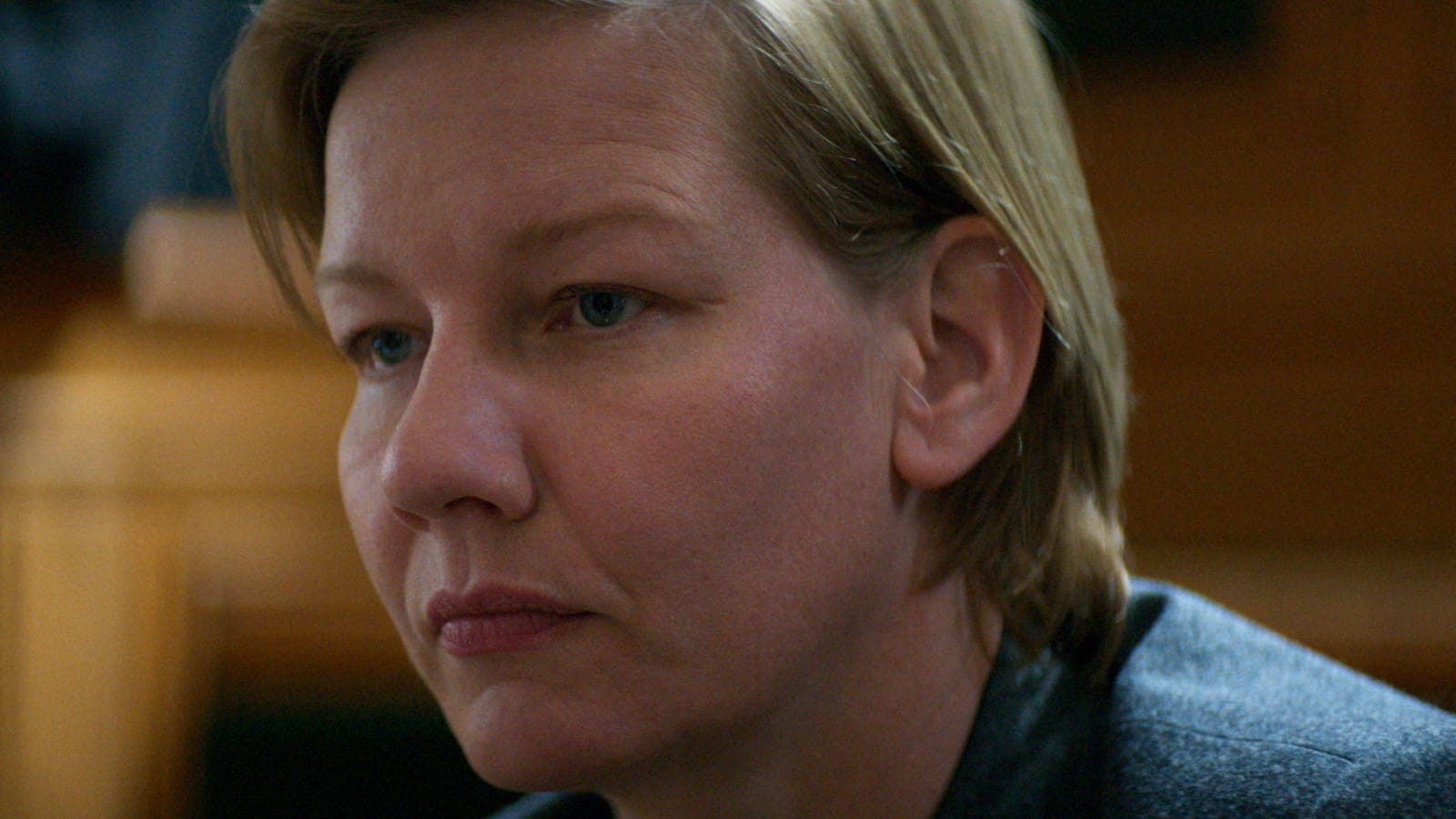
But what if she did kill him? What then? That is, after all, the binary ambiguity that the film does not so much invite as it does force us to consider: the cat is in the box with the vial of poison, but we cannot open the box. And everything rests on what we decide to believe about the cat—or dog, perhaps—in our thought-experiment. Let’s give the other side a chance, now, and proceed as if we were highly skeptical of Sandra—as if we were the prosecution, so to speak.
To keep things neat and tidy, we may invert the method of this essay’s first half: where Eliot’s disdain for Hamlet led us to view Anatomy rather positively (as an affirmation of ambiguity in defense of love), perhaps Stanley Cavell’s obvious affection for Shakespeare and serious interest in Hamlet will enable us to render Anatomy’s darkness visible. And if we do turn to Cavell’s essay “Hamlet’s Burden of Proof,” we first find a succinct statement of his view of Shakespearean tragedy:
tragedy is the result, and the study, of a burden of knowledge, of an attempt to deny the all but undeniable (it may begin, or seem to, as a simple wish to test it)… (179)
To which we may respond by asking, of Anatomy and of its protagonist, Daniel: what is undeniable here? The answer, of course, is nothing so melodramatic as the positive guilt of the mother, but rather—and as in Hamlet—the possibility of her guilt, which must be denied so long as it is possible to do so, or, more precisely, for as long as the truth remains indeterminate. Daniel rather obviously does not wish to accept that his mother may be guilty, and we can interpret his actions as being intended to bring about an objective affirmation of her innocence—that is, a legal exoneration. The frailty of such an affirmation is, of course, indicated by Sandra’s melancholy observation that when one is found not guilty there is no ‘prize’: only nothing, instead of the worst possible outcome.
Let’s emulate Daniel and conduct an experiment—violently, if necessary. Let’s assume that Sandra is guilty and see what happens. Again Cavell turns out to be generative. By way of Freud’s theorization of the ‘primal scene,’ Cavell suggests that:
Hamlet feels [Gertrude’s] power as annihilating of his own […] in speaking of catching the king’s conscience Hamlet was thinking of her, hence that he fantasizes her as the king of that world [i.e. Elsinore], the object in view of whose favor of power people kill and return from the grave and drive others mad (185)
It is true, after all, that Gertrude may be, in some sense, the most powerful character in the play. Even her death is remarkably willful—far more so than Hamlet’s:
KING: Gertrude, do not drink.
QUEEN: I will, my lord. I pray you pardon me. (5.2.273-4)
We will never know for what exactly she begs pardon. The ghost, who seems to know more than a mortal would,5 grants her a special dispensation, or immunity from the revenge-program he inflicts on Hamlet, as if the question of her guilt were unbearable—and here the problem of attempting to deny the undeniable (the question of Gertrude’s complicity or guilt is expressly non-trivial) returns in another form:
But howsomever thou pursues this act
Taint not thy mind nor let thy soul contrive
Against thy mother aught; leave her to heaven
And to those thorns that in her bosom lodge
To prick and sting her. (1.5.84-7)
I quote this passage again in order to give us the opportunity to see it anew: is the ghost demanding that Hamlet enact revenge without destroying the entire family, or is he inflicting on Hamlet a pathological inability to think about Gertrude’s guilt? As Cavell suggests: “Hamlet divines that his father experienced Gertrude’s annihilating power before him” (185). This is of course yet another ‘doubling’ we may add to the prodigious collection of doublings (and triplings or re-doublings) critics have amassed in their observations on this play.
The psychoanalytic details of Cavell’s reading of Hamlet needn’t concern us here. The point, for us, is that it would not actually be reductive or simplistic to conclude that Sandra is either an innocent caught in a legal nightmare and rescued by her son, who must prematurely or precociously bear the weight of ambiguity on his shoulders, or else she is a murderer and a very skilled dissembler who uses her son as she used her husband—to whom she, apparently, is “a monster.” Either way, we have to recall that she tells Daniel what Gertrude never bothered to say: “I’m not a monster.” Does this lady protest too much? As with Gertrude, we won’t ever know. The dead are not always more mysterious than the living.
Cavell says of Hamlet that:
the father’s dictation of the way he wishes to be remembered—by having his revenge taken for him—exactly deprives the son, with his powers of mourning, of the right to mourn him, to let him pass. (188)
But in Anatomy the situation is inverted: it is not the dead father but the living mother who is most problematic. Then again, I think we have already seen that this is also the case in Hamlet: Gertrude, and not Claudius, is Hamlet’s true problem. Killing comes easily to Hamlet—it is every other kind of reaction to other persons that he finds difficult.
Nothing that Samuel says in Anatomy may be said to “curse” Daniel (a word Cavell uses), but it would be possible to conclude that when Sandra assures Daniel of what should have required no reassurance—that she is not a “monster,” that she isn’t a “dog” after all—he is cursed with ambiguity, with the very possibility his mother has just denied. So not only is Daniel attempting to mourn his father: he must also mourn for unconditional, unambiguous love between he and his mother. As Cavell concludes:
Shakespeare's Hamlet interprets the double staging of human birth—which means the necessity of accepting one's individuality or individuation or difference, say one's separateness—as the necessity of a double acceptance: an acceptance of one's mother as an independent sexual being whose life of desire survives the birth of a son and the death of a husband, a life that may present itself to her son as having been abandoned by her; and an acceptance of one's father as a dependent sexual being whose incapacity to sustain desire you cannot revive, which may present itself to his son as having to abandon him. Hence the play interprets the taking of one's place in the world as a process of mourning, as if there is a taking up of the world that is humanly a question of giving it up. (188-9)
Growing-up is thus, in Anatomy, figured as the work of mourning simplicity and living with ambiguity; Sandra, too, has in some sense ‘fallen,’ and must be mourned no less than Samuel; the scenes in which the court intervenes in the intimacy of Sandra and Daniel may be seen as literalizing the tension produced by the mother’s persistent presence after she has ‘fallen’ into ambiguity. All that remains is the work of mourning. Following Freud and Melanie Klein, Cavell notes that:
the work of mourning is the severing of investment, the detaching of one’s interests, strand by strand, memory by memory, from their binding with an object that has passed, burying the dead. (186)
What it would mean for a person to be capable of such mourning is another question. And if we retain the above reading of Daniel’s testimony as a useful fiction intended to exonerate his mother, we may now also choose to see it in a darker light, as a violent act of mourning—and almost a betrayal of—his father in favor of his mother, as if it had turned out to be necessary for Daniel to metaphorically kill, and bury, his father once more by establishing the case for his suicide.6 And so if we continue to see Daniel as the superior writer of the family, as one who can accomplish things with his fictions, we can now observe the underside, or cost, of such a ‘resolution’ of the contradiction between art and life: a death, and a painful loss, has been rewritten, with unknowable consequences for the love between a son and a mother. Of course Hamlet also dramatizes the severe cost of negotiating between love for, and obedience to, one’s parents, but in Anatomy things come to a uneasily peaceful halt, instead of exploding into tragic violence.
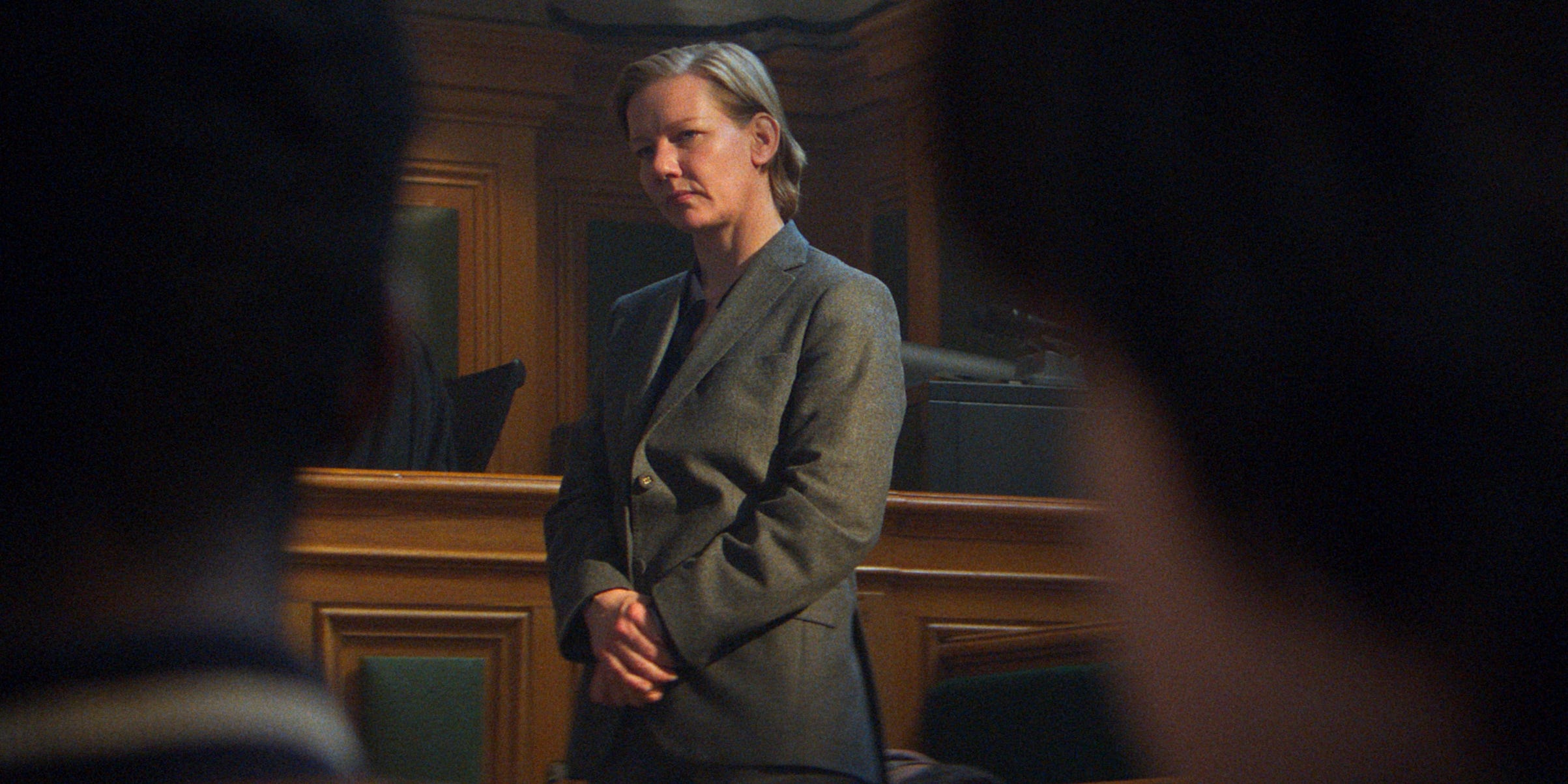
So what, in the end, does Sandra look like to us? innocent? guilty? a mother? a dog?
As Marge advises Daniel late in the film: “To get out of doubt, we are sometimes forced to decide.” This may seem like a rather direct statement of the film’s meaning, but it should be seen as a red herring. The meaning of Anatomy of a Fall is not positive, but negative.
We are not led by the film toward a happy and classically comedic resolution in which trust, love, and familial bonds are strengthened by an ordeal and by the decision to trust, love and strengthen those bonds. We are, instead, allowed to see that trust is a decision, that love can mean “being in uncertainties, mysteries, doubts, without any irritable reaching after fact and reason” (as Keats defines “negative capability”), and that the bonds of family are not so much strengthened or weakened by uncertainties and doubts as they are transformed by them. And so the interesting difference between Hamlet and Anatomy is not that one has a happier, less violent ending than the other, but rather that by virtue of the characters surviving the plot, we are allowed to witness transformation rather than a death-driven tragic apotheosis. The ending of Anatomy is remarkable precisely because it is really a beginning: now comes the hard part. It turns out, as Hamlet understood, that living is harder than dying—but we have reason to believe that Sandra and Daniel are up to the task (to say nothing of Samuel). Whether that makes the two of them admirable is not for me to say—but I would not go so far as to say that the question is unanswerable.
The nice thing about fictional characters is that one cannot put them on trial—one can only ask what import they have for those of us among the living. Beyond comedy and tragedy—beyond fiction—lies something more complicated: what people have alternately called reality, or the Real, or History. Whether we laugh or cry when we meet it, and what that reaction means, is left for us to ask of ourselves.
All these games, by the intensity of their effects, demonstrate the importance of the boundary they tax their ingenuity to overstep, in defiance of verisimilitude—a boundary that is precisely the narrating (or the performance) itself: a shifting but sacred frontier between two worlds, the world in which one tells, the world of which one tells. Whence the uneasiness Borges so well put his finger on: "Such inversions suggest that if the characters in a story can be readers or spectators, then we, their readers or spectators, can be fictitious." The most troubling thing about metalepsis indeed lies in this unacceptable and insistent hypothesis, that the extradiegetic is perhaps always diegetic, and that the narrator and his narratees—you and I—perhaps belong to some narrative. (Genette 236)
Works Cited
Cavell, Stanley. Disowning Knowledge in Seven Plays of Shakespeare. Cambridge, 1987.
Eliot, T. S. Selected Essays. Faber & Faber, 1951.
Garcia, Lawrence. “Cannes Dispatch: Shapes of Things.” MUBI Notebook, 25 May 2023. https://mubi.com/en/notebook/posts/cannes-dispatch-shapes-of-things
Genette, Gérard. Narrative Discourse: An Essay in Method. Translated by Jane E. Lewin. Cornell, 1980.
Shakespeare, William. Hamlet, edited by Ann Thompson and Neil Taylor, revised ed., Bloomsbury Arden Shakespeare, 2016.
Eliot was a devoted reader of detective mysteries, so it’s not impossible to imagine him also enjoying a courtroom-drama; the film of Murder in the Cathedral would seem to imply that he had nothing, in principle, against the cinema either.
For example: when Sandra tries to encourage Daniel to get out of bed and go outside, she begins to resemble (all too disquietingly) Gertrude’s admonition/appeal:
Good Hamlet, cast thy nighted colour off
And let thine eye look like a friend on Denmark [i.e. Claudius].
Do not forever with thy vailed lids
Seek for thy noble father in the dust.
Thou knowst ‘tis common all that lives must die,
Passing through nature to eternity. (1.2.68-73)
“The Hamlet Doctrine” is also the subtitle of Simon Critchley and Jamieson Webster’s entertaining and suggestive study of Hamlet, Stay, Illusion!
In Genette’s narratological terms, this constitutes “metadiegetic narration,” that is, a narration within the diegesis.
If old Hamlet was asleep when Claudius poured poison in his ear, how did he learn that this happened? Moreover, the ghost rather ostentatiously establishes his pseudo-bona-fides by assuring young Hamlet that if he could speak of purgatory, what he had to say would shock and amaze:
But that I am forbid
To tell the secrets of my prison-house
I could a tale unfold whose lightest word
Would harrow up thy soul, freeze thy young blood,
Make thy two eyes like stars start from their spheres,
Thy knotted and combined locks to part
And each particular hair to stand on end
Like quills upon the fearful porpentine—
But this eternal blazon must not be
To ears of flesh and blood. (1.5.13-22)
This is, then, a kind of variation on the divorce-drama: how can a child choose between their parents?