
History is What Hurts
On the novelism of Graham Greene
His beliefs are his own affair; we are merely concerned with his fiction.
—Anthony Burgess
It must all be considered as if spoken by a character in a novel.
—Roland Barthes
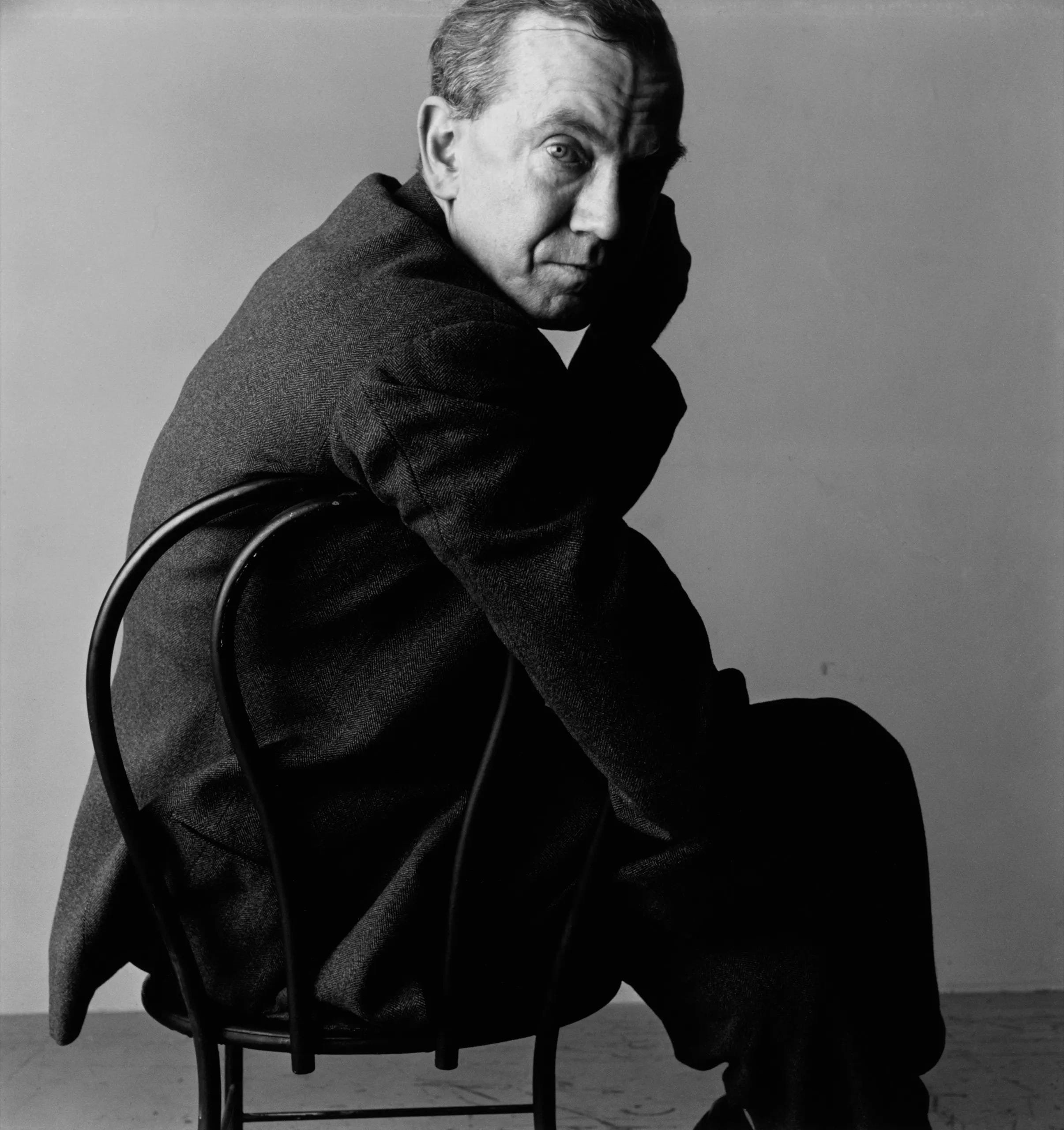
What is a novel for? Perhaps the famous distinction Graham Greene drew between his ‘novels’ and his ‘entertainments’ can still—for all the critical comment it has received through the decades—be of some help in answering this question. Because of course Graham Greene seldom wrote anything that was either a novel or an entertainment alone, and though today we are accustomed to speak not of ‘novels’ or ‘entertainments’ but more usually of ‘texts’ as such, we can begin by recognizing that, for all the entertainment on offer in Graham Greene’s varied oeuvre (ranging from fiction to drama to screenplays to travelogues to memoir to biography and back again, perhaps, to fiction above all), he is almost certainly defined by his novelism. Some, to be sure, would prefer to characterize Greene as a journalistic writer even with regard to his fiction. But I contend that what is interesting about Graham Greene today is both his form—or the example he provides of the novelist as an actor in the twentieth century—and his content: the actual implications of the fictions he wrote in response to real political situations. As Raymond Geuss suggests in Philosophy and Real Politics:
Any desire to think seriously about the relation between politics and ethics must remain cognitively sensitive to the fact that people’s beliefs, values, desires, moral conceptions, etc., are usually half-baked (in every sense), are almost certain to be indeterminate and, to the extent to which they are determinate, grossly inconsistent in any but the most local, highly formalized contexts, and are constantly changing. None of this implies that it might not be of the utmost importance to aspire to ensure relative stability and consistency in certain limited domains. (3-4)
This passage is useful to the extent that it clarifies what is at stake in, arguably, culture itself—as Fredric Jameson claims in The Political Unconscious—but then also, and perhaps more pertinently, what is at stake in those novels, and indeed those ‘entertainments,’ that take as their subject-matter nothing less than real politics. But this introduces a contradiction: how real can ‘real politics’ be when converted to, appropriated by, or represented within fiction? In other words, how real may a novel be?
Geuss helps us to see part of an answer. What could be more quintessentially novelistic than the half-baked, the indeterminate, the grossly inconsistent, and what is constantly changing? I do not mean to simply suggest that the role of art is to give form to chaos; form is not really as orderly as it might wish to be, and novels are infamously indeterminate. But then again, “relative stability and consistency in certain limited domains” is a fair description of the novel. A novel appears stable and consistent relative to the flux and uncertainty of the history it represents or takes as its inspirational material—or simply as its context—and every text is a limited domain. We may say, then, that for a novelist with political concerns such as Greene demonstrated—or even for someone, like Greene, who has novelistic concerns—each novel is an attempt to turn what is distinctive about fiction toward real politics, and so we can begin by concluding that each of Greene’s novels simply is a political intervention. As Richard Greene memorably proposes, “Graham Greene continues to speak to an unquiet world,” and this is fitting, because much of Greene’s fiction is concerned, unconsciously or else very consciously and deliberately, with the possibilities for and effects of language, of speech and writing, and of the persistence of the cultural past long into the future (xiii).
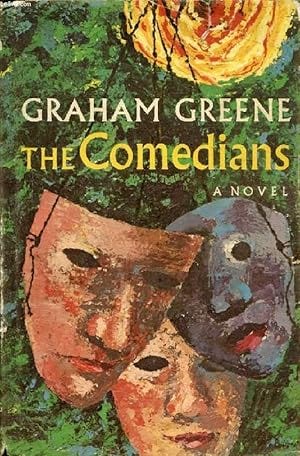
In Greene’s fiction politics tends to seize upon two systems, ideologies, metanarratives, or organizations of belief that are problematic for Greene: Catholicism and Communism. In a famous passage of The Comedians (1966), Greene’s response to the Haiti dominated by ‘Papa Doc’ Duvalier’s regime, the character Doctor Magiot describes in a letter to Brown (the novel’s narrator) the political imperative not to be indifferent:
Communism, my friend, is more than Marxism, just as Catholicism […] is more than the Roman Curia. There is a mystique as well as a politique. […] Catholics and Communists have committed great crimes, but at least they have not stood aside, like an established society, and been indifferent. I would rather have blood on my hands than water like Pilate. […] I implore you—a knock on the door may not allow me to finish this sentence, so take it as the last request of a dying man—if you have abandoned one faith, do not abandon all faith. There is always an alternative to the faith we lose. Or is it the same faith under another mask? (291)
In place of faith one might—perhaps euphemistically—wish to speak of philosophies of history, and following Jameson we will presuppose that
only a genuine philosophy of history is capable of respecting the specificity and radical difference of the social and cultural past while disclosing the solidarity of its polemics and passions, its forms, structures, experiences, and struggles, with those of the present day. (18)
But it is far beyond the scope of this essay to decide—as if once and for all—whether Catholicism or Communism were the “genuine philosophies of history” we are looking for. There is some room for doubt.
This is to say that when we read Graham Greene we need not only concern ourselves with literary form, or with the extent to which readers may rest assured that Greene’s fictions represent the twentieth century’s “specificity and radical difference” with referential accuracy; we need not be exclusively focused on biography, or theology, or political economy. If we read Greene at all today—for reading is never guaranteed, and not quite necessary—it must be because we expect to find that the texts will help us to see the “solidarity” of recent history with the present day. Jameson famously insists that Marxism alone “can give us an adequate account of the essential mystery of the cultural past” (19). But the comments of Greene’s character above indicate a dilemma for anyone who admits religious belief to the discussion: might not faith in Communism be a mask for Catholic faith? or vice-versa? We will quickly recognize that these are not masks one can simply tear off—the matter is undecidable, and we will only be able to move forward along these lines if we decide to consider religion and politics as inextricable. Paraphrasing Jameson, we may say that twentieth-century Catholicism and Communism
can recover their original urgency for us only if they are retold within the unity of a single great collective story; only if, in however disguised and symbolic a form, they are seen as sharing a single fundamental theme—for Marxism, the collective struggle to wrest a realm of Freedom from a realm of Necessity. (19)
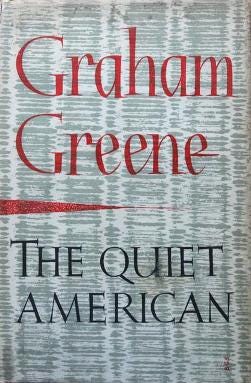
I am attempting to argue, here, that when reading Greene we need not simply subordinate religious concerns with sin and salvation to political concerns with “Freedom” and “Necessity,” precisely because Greene’s fiction suggests that in practice the religious and the political obscure—and disclose—each other. It is not the case that, for instance, the political intrigue depicted in The Quiet American (1955) is simply an occasion or mask for religious turmoil. Instead, the rather important religious and political issue of the knowability of the other (be they a human lover, or God) is forced to a crisis with implications for religion and politics alike.
We can go on now to consider what some of Greene’s novels imply about the relation of the individual to what is more than the individual—be that a congregation or a collective. To be sure, the sympathies of this essay will tend toward the sort of political interpretation Jameson advocates, but I do contend that Greene’s unorthodox Catholicism is an opportunity for readers to think the religious and the political together—not equally or bilaterally, but as two philosophies of history in uneven and potent conflict. It is, after all, by virtue of Greene’s Catholicism that his novels take up such ‘specific’ and ‘radically different’ settings and issues; as Anthony Burgess notes: “The enemies of the true belief walk the great world, not the parish. The politics of Greene are world politics” (95). What that “true belief” was for Greene—let alone for us today—need not be decided here.
In other words, we are concerned now with how Greene’s novels represent or figure the relation of the personal to the political, and The Quiet American may be the one novel in which this problematic is most clearly available for scrutiny. As Paula Martín Salván explains:
The keyword in most readings of The Quiet American (1955) is undoubtedly ‘commitment.’ Around this concept, a recurrent narrative pattern in Graham Greene’s novels may be sketched: conflict is often articulated in terms of an incompatibility between individual and common interests that can only be resolved through a personal sacrifice—an act of true commitment—meant to restore the stability of (legitimate or spurious) communitarian interests. (105)
This is indeed a recurrent pattern in Greene; for our purposes the word “sacrifice” is of interest, because it suggests—once again—that while Greene’s fiction tends to mingle or interweave religious and political dilemmas and situations, it is not necessarily helpful or clarifying for the two to be understood as separate ‘realms’ or fields of inquiry. Salván goes on to claim that many interpretations of The Quiet American follow an “allegorical logic” and, in effect, reduce or ‘decode’ characters as “symbolic representations of larger, political issues” (105). I take issue with Salván’s contention that Fowler and Phuong “resist allegorization,” and I reject the conclusion that Pyle acts “only to ensure that everything will remain the same” (106, 120). I claim, instead, that The Quiet American is allegorical, or symbolically representative, on the level not of characters but of narrative itself. Individual characters in the novel do not represent political positions or ideologies or projects so much as the entire plot—and the whole text as such—is in an overarching way a “distorted and symbolic” allegory of politicization: an uneasy love triangle is not an ‘allegory’ of history, but rather one of its constituent relations.
This is to say that when we read The Quiet American we should emphasize not the ‘journey’ of Fowler from detachment to commitment but, more pertinently, the model that the text as a whole puts forward. And of course The Quiet American, a novel narrated by a journalist, is as Douglas Kerr claims, “a novel much concerned with reading and writing and the relation of both activities to reality” (95). I believe a long descriptive passage that appears early in the novel will demonstrate this:
From the bell tower of the Cathedral the battle was only picturesque, fixed like a panorama of the Boer War in an old Illustrated London News. An aeroplane was parachuting supplies to an isolated post in the calcaire, those strange weather-eroded mountains on the Annam border that look like piles of pumice, and because it always returned to the same place for its glide, it might never have moved, and the parachute was always there in the same spot, half-way to earth. From the plain the mortar-bursts rose unchangingly, the smoke as solid as stone, and in the market the flames burnt palely in the sunlight. The tiny figures of the parachutists moved in single file along the canals, but at this height they appeared stationary. Even the priest who sat in a corner of the tower never changed his position as he read in his breviary. The war was very tidy and clean at that distance. (Greene 46)
This almost literally encapsulates the contradictions and tensions of Greenean ‘perspective,’ and in particular the atypical, for Greene, first-person perspective at work in The Quiet American. We, as readers, are with Fowler looking down, in an echo perhaps of Babel, on an all-too worldly war from the temporary refuge of a church’s pinnacle: as ever, religion and politics threaten to collide. But what is truly fascinating here is the paradox of movement that does not seem to move—the symptom, par excellence, of detached ‘perspective’ as such. Because as long as Fowler merely views the war in Vietnam, reduces it to a spectacle, or to so much journalistic copy, it will always threaten to be unreal and unchanging: it will remain, with obscene falsity, “tidy and clean” when viewed with sufficient distance. So it is not merely journalistic neutrality or detachment that is being challenged and recontextualized here: writing itself, and then most pertinently, the writing of novels, is being interrogated. As Kerr argues: “the novel undergoes a process of inventing itself, and emerges as an instance of a kind of writing that is both critical and self-critical” (95). Kerr’s interest is in the political implications of the dialogue between a text and reality, but other critics have observed similarly metafictional themes in Greene’s other work. For instance, Emily R. Brower claims, in an essay on the sacramental character of written language in Greene, that The Heart of the Matter (1948) is “a novel obsessed with its own medium” (240). So we may assume that for Green there is always, consciously or unconsciously, a third element tangled up with religion and politics: fiction.
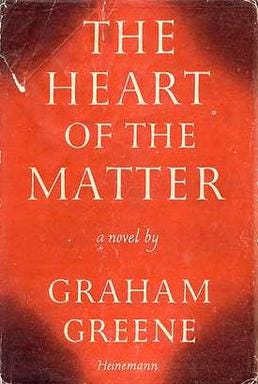
We may say that fiction is not simply, for Greene, a medium: what may be more interesting than Greene’s habits as a novelist is the extent to which fictionality, within his fictions, is precisely what mediates between the personal and the political, and between faith and history. To our surprise, perhaps, when we read The Heart of the Matter we find Scobie attempting to understand his predicament, and the extent to which he understands or misunderstands his wife Louise, in the terms of fiction: “She would understand, he thought, if I were a character in a book, but would I understand her if she were just a character? I don’t read that sort of book” (236). One implication is that reading certain sorts of books might help one to understand oneself and others—and by extension one’s faith and politics and those of others—and Greene’s critics have been fond of this possibility. For instance, in her essay “Passport to Greeneland” Laura Tracy claims that the novels “find a positive and moral vision in Greene’s address to his reader,” and that “Greene’s utopia depends on unflinching self-examination” (45). We might extend this line of argumentation and suggest that Greene’s novels work, in one way or another, to make us conscious of what may be unconscious—and again, we need not choose here, I think, between speaking of a political unconscious or a religious one. In The End of the Affair (1951) Maurice Bendrix provides, as if he were describing the writing process, the way that the reading experience may, in Tracy’s words, offer “the possibility of moral reformation”:
So much in writing depends on the superficiality of one’s days. One may be preoccupied with shopping and income tax returns and chance conversations, but the stream of the unconscious continues to flow undisturbed, solving problems, planning ahead: one sits down sterile and uninspired at the desk, and suddenly the words come as though from the air: the situations that seemed blocked in a hopeless impasse move forward. (Greene 12-13)
Because of course a reader, too, finds that sitting down at a desk or in a chair to read, rather than write, produces a moment in which “words come as though from the air,” and if the reader is very lucky this experience will allow a situation—be it intellectual or interpersonal, religious or political, etc.—that had seemed to be “hopeless” to “move forward.”

So it is not surprising that Greene’s metafictional themes should also indicate for what purpose or project we may read his fictions. In The Heart of the Matter Scobie would seem to ultimately be a negative example of the sort of ‘reader’ of people, of situations, of faith, and of history that Greene aspired to be and to represent in his writing: despair leads Scobie to suicide, and the reader is left to ponder him alongside other such ‘burnt-out cases.’ As Tracy argues, “Greene’s dominant subtext […] is the contrast between Scobie’s pity/love for his wife and mistress and his genuine love for Ali,” the servant who is “symbolic of the authentic love Scobie feels for the country” (47). She goes on to claim that ultimately Scobie has been “deluded by his own sense of heroism” and fails to protect Ali as a result—but as readers of Greene and his critics we can pause here, and reconsider the terms at work in this discussion.
Is a person ever truly, finally, or most pertinently a symbol of their country or homeland or place? Why are we so reluctant to allow characters, as representations or images of people, to be simply characters, in the way that we might wish for persons to be allowed to be just that? This leads us back, and in chronological terms, onward to The Quiet American and the question of how, exactly, it may function allegorically. Where Salván claims that Fowler and Phuong “resist allegorization” and thereby unsettle or challenge allegorical interpretations of the novel, I want to suggest that it is precisely because Greene’s characters are not, finally, allegorical that his novels, as such, are at a higher level allegorical of their own situations. That is, every time Greene responds in fiction to a real political situation, he does not allegorize those situations in themselves, but rather represents in distorted and symbolic fashion his own predicament in relating to those situations. Greene’s challenge, as a novelist, may find fictionalized expression in the words of Fowler:
Wouldn’t we all do better not trying to understand, accepting the fact that no human being will ever understand another, not a wife a husband, a lover a mistress, nor a parent a child? Perhaps that’s why men have invented God—a being capable of understanding. Perhaps if I wanted to be understood or to understand I would bamboozle myself into belief, but I am a reporter; God exists only for leader-writers.
We will note the cheaply cynical punchline which cannot dispel our sense of a real problem having been covered-over by grim humour and a second-order despair of understanding. Fowler may, like Greene, be a journalist, but Greene was also far more than a journalist, and so the problem of understanding is far from settled—it is, of course, merely raised again for us by this passage. And the plot of the novel goes further, by suggesting that Fowler’s complicity in the assassination of Alden Pyle was the correct political decision no matter how it may taint his happiness with Phuong. The bitter irony, then, is that Fowler should find himself in a ‘happy ending’ that he cannot fully enjoy, and that history will soon take from him anyway as American intervention in Vietnam increases with disastrous consequences. I would suggest that Fowler’s unhappiness should be read as a symptom of the nightmarish historical situation he has not, by the novel’s end, managed to wake from. At least Greene, for his part, could leave Vietnam behind.
It is not that all of Greene’s novels are ‘secretly’ or unconsciously about Greene himself, but simply that Greene’s fiction tends to be most interesting and worthwhile when it implicitly examines itself and thereby models, for readers, precisely such a tendency towards consciousness and self-consciousness. Paradoxically, Greene tends to accentuate this modeling of readerly consciousness—which ought, in one way or another, to bring readers together and not isolate them further—through the theme or image of isolation and silence, or the impossibility of speaking. Scobie cannot make himself understood and, arguably, fails to understand his own feelings and duties, as we have seen. In The End of the Affair Sarah writes: “Well, if pain can make a writer, I’m learning, Maurice, too. I wish I could talk to you just once. I can’t talk to Henry. I can’t talk to anyone. Dear God, let me talk” (Greene 95-6). And Fowler, in the final words of The Quiet American, finds in the depths of his totally ambiguous situation that he simply wishes to confess: “Everything had gone right with me since [Pyle] had died, but how I wished there existed someone to whom I could say that I was sorry” (189). As Kerr suggests, “since [Fowler] cannot unburden himself to priest or police, the only person who can fulfil this perlocutionary task for him is the reader of his narrative, which as a confession is […] the only [genre] that lies under an absolute obligation to tell the truth” (102-3). Our concern is not with Fowler’s desire to confess but rather with the meaning of Greene’s writing of such a fictional confession. What in Fowler’s betrayal, and ambiguously happy ending, is of greater and broader significance than any one man or character? Or, as Kerr asks: “Is the fiction of The Quiet American one of those lies that can be an example of the truth?” (103).
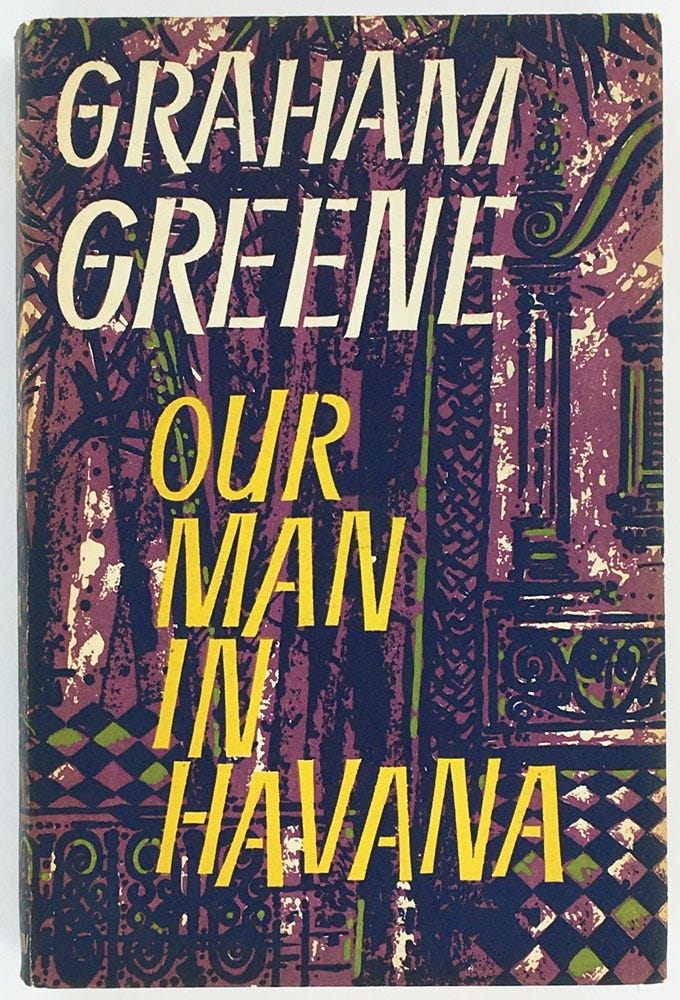
We have been considering the relation of fiction to truth all along, and The Quiet American, perhaps more than even Our Man in Havana or The Comedians, has seemed to become somehow ‘more true’ as the years passed and as war took an increasingly devastating toll on people in Vietnam and surrounding countries. In his study of the novel’s reception, Oscar Jansson concludes that:
the case of The Quiet American shows how the background noise of history changes not only over time or what the text is taken to mean, but what the text is taken to be. The effect, in other words, of the successive turn to history in The Quiet American’s reception is an erasure in the critical record of its potentiality of being seen simply as fiction; as a novel rather than prophetic journalism, a personal ideological statement, or a piece of history. (547)
But this is a misguided or mistaken defense of Greene’s novelism. No novel is ever “simply” fiction, and as Stephen J. Whitfield suggests, “if the historian is allowed to wonder if the disaster [in Vietnam] could have been prevented, attention should be paid to The Quiet American as a warning signal that was ignored” (66). This is what is really at stake when we read The Quiet American today: its relation not merely to its own context, but also to the ways its meaning has been changed by subsequent history. Vietnam’s history means that The Quiet American’s concerns with personal and political relations are more obviously pertinent for us, but as I have attempted to demonstrate, this paradigm of fictional political intervention and exploration—modeling for the reader doubt and consciousness of personal, religious, and political certainties—defines Greene’s fiction at its best, or if we prefer, at its most interesting. Anthony Burgess concludes, in his account of politics in Greene’s novels, that “fiction […] has to be stranger than truth” (99). But in a detailed account of Greene’s actual, historical involvement in Vietnam, Kevin Ruane explains that
there was a brief period in 1950-1 when the British were also active in this regard [looking to support a ‘Third Force’ distinct from communism and colonialism] and when Greene found himself caught up in the kind of plot, and involved with a cast of characters […] that would not have been out of place in one of his own novels. Fact, in this case, was just as compelling as fiction. (452)
And the point here is that Vietnam’s facts—its history and that of its people—were, and turned out to be, far more compelling than any novel. As Douglas Kerr reminds us, “contemporary reality is quite capable of enriching and modifying the meaning of a book in retrospect” (105). Literary critics may be concerned with how a work of fiction represents, responds to, and even acts within its social, political, and historical context, but it is also the case that history can change—sometimes with drastic force—the meaning of a novel, or even of an author.
So we may be forgiven for asking today what Graham Greene is for—not in the sense of probing the man’s political commitments and religious beliefs, but simply in terms of what we may learn—about religion and politics, fiction and history, persons and nations—by reading him. As Richard Greene suggests, Graham Greene is “one of the very few modern writers in English who can be valued for a whole body of work”—and especially, I would claim, for a whole series of novels, here represented by a select few (xiii). A longer and more comprehensive essay along these lines would become a catalogue of the specific ways that Greene’s problems and concerns are in solidarity with those of the present. I believe we can clarify the significance of Greene’s fiction by turning to one specific aspect thereof: character. Characterization is famously problematic in The Quiet American; we have already considered one scholar’s view of the extent to which Fowler and Phuong, for instance, “resist allegorization” and disturb the otherwise coherent organization of the novel along lines of national identification, where Pyle represents the dangerous, naïve ‘innocence’ of American intervention, Fowler the jaded detachment and lingering attachments of fading British imperialism, and Phuong the supposed dependence and mystery of Vietnam, if not of the entire ‘East’ or ‘Orient’ as such. Beth Kramer, for example, claims that “Phuong, as a woman and former colonized individual, is the perfect figure to represent the oppressed colonized body in an asymmetrical political world” (11). But I find this sort of analysis strange and reductive, because it is, in fact, the extent to which Phuong is real—that is, how far she may be said to be both a plausible individual and a participant in Vietnamese collective history—that she is of political significance. And though critics like Kramer are eager to take up Fowler’s obviously unreliable narration as evidence against him in the court of Orientalism—as in Kramer’s claim that “Fowler constantly speaks of his mistress as an empty and passive object, and he looks to her body rather than to her mind to satisfy his desires” (11)—I find that this mode of critique does little more than essentialize otherness all over again. The problem is in refusing to see precisely the unknown complexity that Fowler, ultimately, imputes to Phuong, and which we should recognize as signifying respect as the basis for the possibility, at the very least, of a less intensely and painfully asymmetrical politics:
‘She’s no child. She’s tougher than you’ll ever be. Do you know the kind of polish that doesn’t take scratches? That’s Phuong. She can survive a dozen of us.’ […] But even while I made my speech and watched her […] I knew I was inventing a character just as much as Pyle was. One never knows another human being; for all I could tell, she was as scared as the rest of us: she didn’t have the gift of expression, that was all. And I remembered that first tormenting year when I had tried so passionately to understand her, when I had begged her to tell me what she thought and had scared her with my unreasoning anger at her silences. Even my desire had been a weapon […] (Greene 134)
We come back, in conclusion, to language and its difficulties: in this passage we see that what is wrong between Fowler and Phuong is not that their respective histories have produced an insurmountable difference or disparity between them, but rather that a simple—and very material—language barrier has stopped understanding in its tracks. It is all too easy to say, as Fowler does, that “one never knows another,” but that does not usually stop human beings from trying. Fowler’s vice, or his error, is to substitute for a real political problem—a difference in languages—a sham metaphysical problem of interpersonal understanding. And this has been indicated for us already in The Heart of the Matter and The End of the Affair. Greene’s unhappy lovers may claim that they cannot speak to anyone of their unhappy or failed or thwarted or, in Fowler’s case, morally compromised affairs—but in each case the text itself has always already constructed, for the reader, a situation of disclosure or confession. It is as if Greene’s novels set out to demonstrate—be it through first-person narration or free indirect discourse—that speaking and listening, and perhaps understanding, are no less possible for seeming to be intractable. In Greene’s hands, the spy novel—or to speak more broadly, the novel that concerns itself with real politics, from which espionage is today inextricable—moves as if to collapse the distance and distinction between the personal and the political, so that we are not concerned with allegories or symbolism so much as we are with imbrication, implication, and resonance: the meaning of the personal is political, and vice-versa. And as Penny Fielding explains: “the spy novel […] takes its point of departure from a political context, offering a fictionalized narrative to real-world conflicts between nation states or other political entities. [Spy novels] act as uneasy proxies to history—narratives that have a synecdochic relationship to historical events” (34). In fact individuals, too, have a synecdochic relationship to historical events: what happens to one person, or what they do or say, may in itself be political, but it may also stand as a particular instantiation of a general trend, or pattern, or narrative. And so when, at the end of Greene’s last spy novel, double-agent Maurice Castle finds himself separated indefinitely from his family, his silence proves resonant: “[Sarah] said, ‘Maurice, Maurice, please go on hoping,’ but in the long unbroken silence which followed she realized that the line to Moscow was dead” (265).
Silence, for Maurice as for so many of Greene’s characters, is not merely a personal predicament, a metaphysical dilemma, a question of language barriers, or guilt, or confession—it is the sound of a material separation wrought by history:
History is what hurts, it is what refuses desire and sets inexorably limits to individual as well as collective praxis, which its ‘ruses’ turn into grisly and ironic reversals of their overt intention. But this History can be apprehended only through its effects, and never directly as some reified force […] we may be sure that its alienating necessities will not forget us, however much we might prefer to ignore them. (Jameson 102)
To Graham Greene’s credit, one cannot pretend that he ever ignored the necessities of twentieth-century history. Any imperfections in his representations notwithstanding, Greene’s mode of fiction—intimately related to journalistic observation and concrete experience, divided between religious and political concerns, uneasily inspired by the author’s life, views, and relationships, serious and yet devoted to humour—is one that registers for its readers the contradictions of writing, as such, in the modern era. In that way, Greene’s example is not necessary, nor essential, but merely important—a fine thing for a novelist, of all things, to be.
Works Cited
Brower, Emily R. “‘If I Were in a Book’: Language and Sacrament in Graham Greene’s The Heart of the Matter.” Renascence, 2017, vol. 69, no. 4, pp. 240-53.
Burgess, Anthony. “Politics in the Novels of Graham Greene.” Journal of Contemporary History, 1967, vol. 2, no. 2, pp. 93-99.
Fielding, Penny. “Passages of Arms: Postwar Fictions of Espionage.” Representations, 2023, vol. 163, pp. 34-50.
Greene, Graham. The Heart of the Matter. 1948. Vintage, 2019.
—. The End of the Affair. 1951. Vintage, 2019.
—. The Quiet American. 1955. Vintage, 2001.
—. The Comedians. 1966. Vintage, 2019.
—. The Human Factor. 1978. Vintage, 1999.
Greene, Richard. The Unquiet Englishman: A Life of Graham Greene. W. W. Norton & Co., 2020.
Geuss, Raymond. Philosophy and Real Politics. Princeton UP, 2008.
Jameson, Fredric. The Political Unconscious: Narrative as a Socially Symbolic Act. Cornell UP, 1981.
Jansson, Oscar. “The Resonance of Conflict: Genre and Politics in the Transatlantic Reception of The Quiet American.” Canadian Review of Contemporary Literature, 2020, vol. 47, no. 4, pp. 533-551.
Kerr, Douglas. “The Quiet American and The Novel.” Studies in the Novel, 2006, vol. 38, no. 1, pp. 95-107.
Kramer, Beth. “‘Postcolonial Triangles’: An Analysis of Masculinity and Homosocial Desire in Achebe’s A Man of the People and Greene’s The Quiet American.” Postcolonial Text, 2008, vol. 4, no. 4, pp. 1-14.
Salván, Paula Martín. “‘Being involved:’ Community and Commitment in Graham Greene’s The Quiet American.” Community in Twentieth-Century Fiction, edited by Paula Martín Salván, Gerardo Rodríguez Salas, and Julián Jiménez Heffernan. Palgrave Macmillan, 2013.
Tracy, Laura. “Passport to Greeneland.” College Literature, 1985, vol. 12, no. 1, pp. 45-52.
Whitfield, Stephen J. “Limited Engagement: The Quiet American as History.” Journal of American Studies, 1996, vol. 30, no. 1, pp. 65-86.